Scalability

OpenTofu & Terraform Modules

Brainboard is the single source of truth for all your OpenTofu Terraform modules: private, public, and community. Quick reuse, built-in governance, and full compatibility with any provider - all in one place. Start for free today!
a screenshot of a module being dragged to a containera screenshot of a terraform module being dragged into a container

One Catalog for All Your OpenTofu/Terraform Modules

When modules are scattered across dozens of repositories, teams stop using them - simply because they don't know they exist. Brainboard solves this with a centralized catalog that makes all OpenTofu Terraform modules - private, public, and community - visible, accessible, and easily reusable.Version pinning, tag search, dependency visibility - it's all there. New engineers onboard faster, code duplication disappears, and patterns become consistent. At the same time, Brainboard supports both OpenTofu and Terraform workflows without painful migrations - just plug in and get to work. OpenTofu vs Terraform - a question that increasingly arises in teams. Brainboard removes this tension by supporting both tools within a single workflow. OpenTofu Terraform compatibility covers provider support, state handling, and module interoperability patterns - so you can mix and migrate without fear of breaking anything in production.

Modules’ catalog

Create your internal library of modules and share it with your teams
a screenshot of a modal with a list of terraform modules to import

Embedded documentation

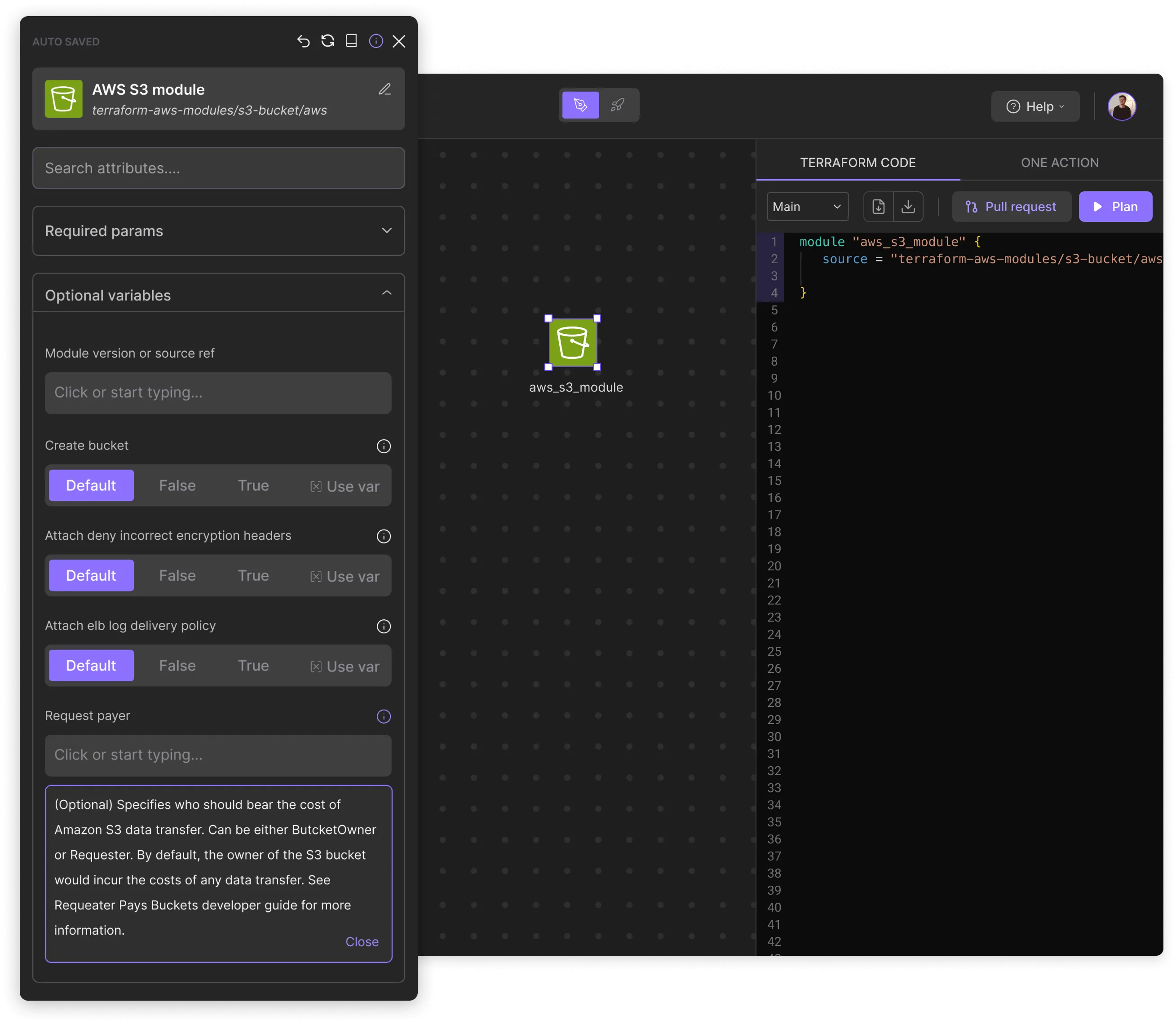
Brainboard is able to read the modules’ source code to extract the documentation
a screenshot of a modal with Terraform module configurationsadd terraform module

Highly customizable configuration

You have full control of every aspect of modules
Configure terraform resources

Native citizens

cloud infrastructure designercloud provider integration
terraform and opentofu modules

Build Your Modules Service Catalog

A good catalog is not just a list of modules. It is a living system with tags, owners, an approval process, and a history of changes. In Brainboard, you create and manage modules with full control: import from Git or public registries, assign owners, track dependencies, and changelogs. Teams can see what has been approved for use and what is under review. The result is reliable building blocks that speed up delivery and prevent standards from becoming mere wishes.

cloud diagram configuration

Embedded documentation

Documentation that no one reads because it's somewhere in Confluence is not documentation. Brainboard automatically parses the module's source code and displays inputs, outputs, and examples right in the interface. Engineers can see what the module accepts, what it returns, and how to configure it correctly - without switching contexts.Built-in hints and validation reduce errors, which means fewer tickets, cleaner handoffs between teams, and more confident work with OpenTofu Terraform documentation. Autonomy for all levels - from junior to architect.

terraform as diagram

Highly customizable configuration

Standardization does not mean inflexibility. In Brainboard, you target a specific version, branch, or tag of a module, configure variables with presets, set policy-guarded defaults, and environment overlays. Visualization of dependencies and inputs helps you understand what affects what, even before deployment. The result: each team uses OpenTofu Terraform modules as needed by the platform, while retaining flexibility for their specific tasks. Fewer code review conflicts, more confidence in what goes into production.

cloud infrastructure designer

Native citizens

Modules in Brainboard are not third-party components cobbled together. They live on the canvas alongside regular Terraform resources as native citizens. The platform natively supports private, public, and community modules and automatically determines the relationships between them and vanilla resources. This gives you deeper control over the composition of your infrastructure: you can see how modules interact with each other, where dependencies arise, and where potential conflicts lie - right at the design stage, rather than after a failed application.
Centralize your modules, documentation, and governance in Brainboard - with full support for OpenTofu Terraform and Terraform. Start for free and make modules a real standard for your team.

cloud infrastructure designercloud diagram configurationterraform as diagram
terraform and opentofu modules

Your questions, answered.

Didn’t find the answer to your question?

How does Brainboard ensure architecture changes are automatically propagated across environments?

Plus Circle - Icon

What does it mean to keep environments DRY (Don't Repeat Yourself) in Brainboard?

Plus Circle - Icon

Can I customize which environments are synced when changes are made to the architecture?

Plus Circle - Icon

How does Brainboard handle environment-specific variables and secrets while syncing architectures?

Plus Circle - Icon

Does Brainboard support syncing architecture across multiple cloud providers or just one?

Plus Circle - Icon

Didn’t find the answer to your question?

It’s up to you now to build great things.